Solver vs Datarails: Which FP&A Platform Fits Growing Mid-Market Teams?
Choosing financial planning and analysis (FP&A) software takes more than an Excel connection. CFOs and finance leaders need to know how many data sources each plan covers, how fast connected reports go live, and whether one data model can scale with every new entity and department. Solver fits growing mid-market finance teams that need multi-entity consolidation and data from across the business as they scale.
Compare Data Foundations and Platform Scope
Below is a side-by-side comparison based on publicly available information, current as of November 2026.
New York-based FP&A provider founded in 2015. Datarails connects existing Excel and Google Sheets models to FinanceOS, its governed data layer, and sells FP&A alongside close, cash, and spend products. It raised a $70 million Series C in January 2026.
An AI-accelerated FP&A platform that provides planning, reporting, and consolidation data for mid-market teams in one relational SQL data warehouse. Capabilities such as Solver Copilot, Agent Studio, and Connector Studio extend the platform and work natively with your Solver data.
Solver connects to ERP, CRM, and other data sources an organization already runs on. Patented QuickStart deployment delivers pre-built reports, dashboards, and budget forms for supported ERPs, and the Solver Template Marketplace adds tailorable industry templates for planning, reporting, consolidation, and analysis.
Solver is privately held, so product roadmap and pricing decisions stay focused on customers rather than outside investors.
Datarails vs Solver: Side-by-Side FP&A Comparison
| Datarails | Solver | |
|---|---|---|
|
Foundation |
Datarails runs existing Excel and Google Sheets models on FinanceOS, a governed data layer that applies mappings and consolidation rules before data reaches each workbook.
|
Solver stores all data in a unified relational SQL star schema on Azure, so reports, input forms, dashboards, and Solver Copilot all read from one data warehouse. Clean, structured data gives AI analysis a reliable foundation.
|
|
Scalability |
Published plans range from 2 users and 1 integration (Professional) to 15 users, 50 viewers, and 3 integrations (Expert), with custom Enterprise plans above.
|
Solver's data warehouse supports unlimited data sources and multi-entity consolidation for growing mid-market organizations.
|
|
Implementation |
Datarails reports 4 to 6 weeks for most FP&A implementations, delivered by its own team for a one-time onboarding fee.
|
QuickStart connectors deliver the first live reports, dashboards, and budget forms in days for supported ERPs, with implementation and support available directly or through a global network of certified partners.
|
|
Integration |
Datarails lists more than 600 data sources, but its published plans include one to three integrations depending on tier.
|
Solver’s data warehouse supports unlimited data sources, including CRM, Microsoft Fabric, and other business systems. QuickStart for Business Central, Dynamics 365 Finance, Sage Intacct, and Acumatica delivers pre-built reports, dashboards, and budget forms, so finance starts with working content instead of raw connected data. View all integrations.
|
|
User Experience |
Teams keep their own workbooks and formulas in Excel or Google Sheets, or work in the Datarails web app.
|
Design reports and input forms in native Excel, then share them through the Solver web portal. Solver Copilot, built for FP&A workflows, includes a Help Agent for product questions and an Analysis Agent for anomaly detection, trend identification, root cause analysis, and predictive recommendations.
|
|
Pricing |
Datarails cites $35,000 to $80,000 per year for typical mid-market customers and enterprise typically start above $100,000, plus a one-time onboarding fee.
|
Solver provides all-inclusive pricing across planning, reporting, consolidation, analysis, and data warehousing.
|
|
Best Fit |
Datarails suits teams that want to keep existing spreadsheet models and add close, cash, and spend tools on one data layer.
|
Solver suits mid-market finance teams that want a standardized planning and reporting model with data from across the business.
|
Go Live with Pre-Built Content, Not Just Connected Data
Datarails
Datarails reports 4 to 6 weeks for most FP&A implementations, and says FinanceOS can be live in a few business days. Finance still builds and maintains its own workbook models.
Solver
QuickStart for Microsoft Dynamics 365 Business Central, Dynamics 365 Finance, Sage Intacct, and Acumatica delivers connected reports, dashboards, and budget forms in days, so teams start with working content.
“Since Finance worked with Excel significantly, Solver appeared to be the obvious choice. This, coupled with the fact that we could easily get at our data, was something that Pine State Trading was in definite need of.”
Phil Thibodeau, Financial Services Manager, Pine State Trading
Bring Every Data Source into One Warehouse
Datarails
Datarails lists 600+ data sources. Published plans include one to three integrations, depending on tier.
Solver
Solver's data warehouse supports unlimited data sources, with pre-built ERP, CRM, and Microsoft Fabric connectors and 30GB of storage included, feeding both Power BI and Tableau. The more data finance brings into the warehouse, the more context Solver Copilot has to surface insights across the business.
Standardize Planning Without Leaving Excel
Datarails
Teams keep their existing Excel or Google Sheets models and formulas, with FinanceOS feeding governed data underneath. Ask how logic spread across many workbooks is reviewed and updated when the business changes.
Solver
Finance designs reports and budget input forms with native Excel formulas over one SQL star schema. Business users submit data through the Solver web portal, and workflow and approvals keep every cycle on track with a full audit trail.
How to Choose the Best FP&A Software
Comparing Datarails alternatives? Download our free FP&A software guide to choosing the right platform for your ERP and finance team.
Why Finance Teams Call Solver a Leader in FP&A
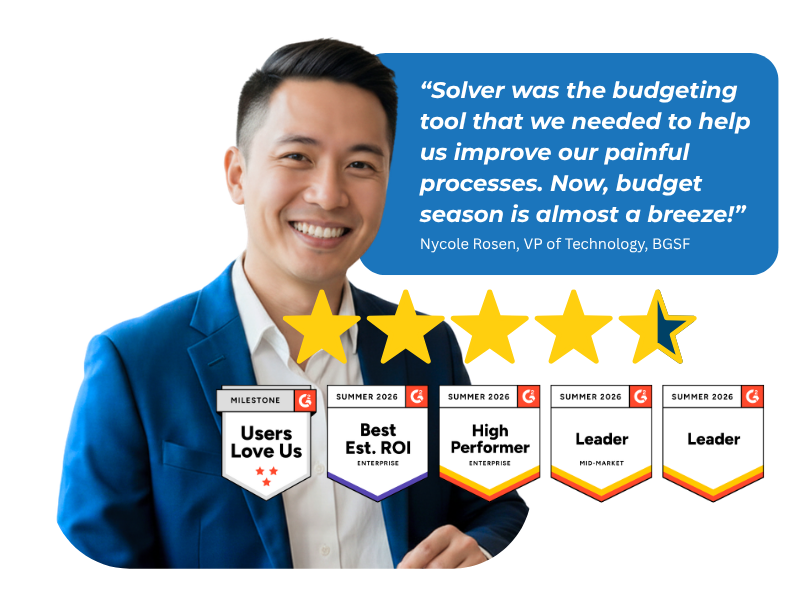
G2 users recognize Solver as a Leader for financial planning and analysis, with finance professionals across nonprofit, manufacturing, distribution, and dozens of other industries relying on it daily. Whether you're a mid-market team or a global enterprise, Solver gives you one platform to budget, report, consolidate, and analyze with confidence. Nycole Rosen, VP of Technology at BGSF, put it plainly: "Now, budget season is almost a breeze."
Compare Total FP&A Investment
| Cost factor (Pricing model) | Datarails (Custom quote, tiered plans) | Solver (Custom quote) |
|---|---|---|
|
What's included |
Three plans: Professional, Premium, and Expert. Spend is added at Premium; Cash Management, Month-End Close, Receivables, and Desk are added at Expert. AI Storyboards and premium support are not included in Professional. Custom Enterprise plans available.
|
The Solver Platform: includes planning, reporting, consolidation, analysis on the Solver Data Warehouse. Solver Copilot and other AI capabilities work natively with your Solver data.
|
|
Users and data sources |
Professional: 2 users, 1 integration. Premium: 5 users, 2 integrations. Expert: 15 users, 50 viewers, 3 integrations.
|
Unlimited data sources through the Solver Data Warehouse.
|
|
Time to first reports |
4 to 6 weeks for most FP&A implementations (Datarails-reported)
|
Days, with QuickStart integrations for leading ERPs and CRMs.
|
|
Ongoing maintenance |
Finance maintains its own workbook models
|
Reports and input forms managed by finance in native Excel over one SQL data model
|
|
Data storage |
Not published
|
30GB included
|
|
Ownership |
Venture-backed; $70 million Series C in January 2026
|
Privately held
|
Information on this page is based on independent research using publicly available sources and is accurate as of November 2026. Pricing, plans, and features are subject to change. Datarails and FinanceOS are trademarks of their respective owners.
What Does Solver’s Pricing Include?
Solver’s pricing is built around the Solver Platform: planning, reporting, consolidation, and analysis on the Solver Data Warehouse, a core part of the platform. Capabilities such as Solver Copilot, Agent Studio, and Connector Studio extend the platform and work natively with your Solver data. Three things help control cost after go-live:
-
Day-one content. Patented QuickStart integrations deliver pre-built reports, dashboards, and budget forms for leading ERPs and CRMs, including Microsoft Dynamics 365 Business Central, Microsoft Dynamics 365 Finance, Sage Intacct, Acumatica, Salesforce, and HubSpot. The Solver Template Marketplace adds planning templates and Power BI dashboards.
-
Data from across your business. The Solver data warehouse supports all your key data sources, so finance can bring ERP, CRM, and operational data into one model.
-
Finance-owned reporting. Teams build and update reports in Excel with native formulas, with no proprietary formula language and no consultant needed for routine changes.
Comparing Datarails Alternatives?
Solver vs Datarails | Frequently Asked Questions
-
What is Datarails?
Datarails is an FP&A provider founded in 2015 and headquartered in New York, with an office in Tel Aviv. It connects existing Excel and Google Sheets models to FinanceOS, its governed data layer, and offers Month-End Close, Cash, Spend, and Desk products. Keeping familiar workbooks in place is a genuine strength.
-
How does Solver compare to Datarails?
Datarails keeps finance teams in their existing workbooks and governs the data underneath. Solver standardizes planning and reporting on one relational SQL data warehouse with native Excel design, and QuickStart delivers ready-to-use reports, dashboards, and budget forms for supported ERPs. Planning, reporting, consolidation, analysis, and data warehousing come in one suite.
-
What AI capabilities does Solver offer compared to Datarails?
Solver Copilot AI is built specifically for FP&A workflows and is included with each Standard User license. The Help Agent answers product questions, and the Analysis Agent handles anomaly detection, trend identification, root cause analysis, and predictive recommendations. It runs on Azure OpenAI, and user input never trains the model. Because Copilot works directly on the Solver data warehouse, its analysis draws on planning, actuals, and operational data in one structured model, without exporting data to an outside tool. Datarails offers Strategy, Planning, and Reporting agents, plus a FinanceOS AI Connector for tools like Claude and ChatGPT.
-
How long does implementation take compared to Datarails?
For supported QuickStart ERPs, Solver delivers connected reports, dashboards, and budget forms in days. Full implementation depends on data readiness and the scope of planning, security, and consolidation. Datarails reports 4 to 6 weeks for most FP&A implementations, with a one-time onboarding fee on every plan.
-
How many data sources can each platform connect?
The Solver data warehouse supports unlimited data sources, including ERP, CRM, and Microsoft Fabric, with 30GB of storage included. Datarails lists more than 600 data sources, and its published plans include 1, 2, or 3 integrations depending on tier, with custom Enterprise plans available.
-
Which ERPs and BI tools does each connect to?
QuickStart covers Microsoft Dynamics 365 Business Central, Microsoft Dynamics 365 Finance, Sage Intacct, and Acumatica, and Solver connects to both Power BI and Tableau. Datarails integrates with ERPs including Oracle NetSuite, Dynamics 365, Sage Intacct, and QuickBooks, and also lists Power BI and Tableau.
-
What is Datarails FinanceOS?
Datarails launched FinanceOS in March 2026 as a governed data layer that connects financial data to the AI tools a team chooses. Its FP&A, close, cash, and spend products run on the same foundation. Mid-market buyers should ask how plan tiers, integration limits, and onboarding fees apply to their scope.