AI-Accelerated Microsoft Power BI Integration for Finance Teams
Solver works with Microsoft Power BI to give finance teams dashboards built on governed, finance-ready data. Solver’s Power BI connector, built for Power BI, delivers budgets, forecasts, consolidated actuals, and operational data from the Solver Data Warehouse, so your team can build in the Power BI tools it already knows from a single source of truth.
Based on customer reviews on
![]()
Built for and Connected to Power BI
Solver is a planning, reporting, and analysis application built for Power BI. The Solver connector sits in the Power BI Desktop Get Data menu, and pre-built QuickStart templates give your team a head start on the dashboards finance leaders ask for most. Find Solver in the Microsoft Marketplace.
Native Solver Connector
The Solver connector uses the Solver API to access data from the Solver Data Warehouse and handles data preparation before it reaches Power BI. Your administrator chooses which Solver modules to expose, then connects from Power BI Desktop with an API URL and access token.
QuickStart Power BI Templates
Solver QuickStart includes more than 50 pre-built Power BI templates for rapid deployment. Start from a proven dashboard layout, connect it to your Solver data, and tailor visuals to the KPIs your leadership team reviews every month.
Take the Power BI Tour
Watch a video series covering what Solver offers and how the QuickStart integration for Power BI helps teams reach better decisions sooner.
How Solver Extends Microsoft Power BI
One feed for every source
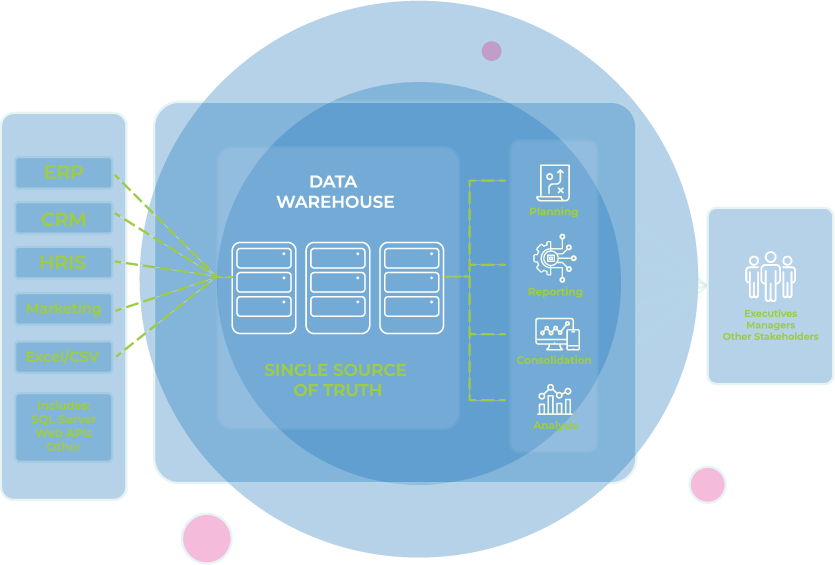
Combine ERP, CRM, payroll, and operational data in the Solver Data Warehouse, then deliver it to Power BI through one connector instead of a separate integration per system.
Finance rules applied first
Run currency translation, intercompany eliminations, and allocations in Solver so Power BI dashboards show consolidated numbers your controller already trusts.
Plans beside actuals
Bring budgets, forecasts, and scenario versions from Solver into Power BI to track performance against plan on the same visuals.
Formatted financial statements
Pair Power BI dashboards with presentation-ready income statements, balance sheets, and cash flow reports built in Solver's Excel add-in.t track every change.
Skills your team already has
Finance designs reports and planning forms in Excel, and analysts build dashboards in Power BI, with both working from the same governed data.
Faster dashboard rollout
Start with QuickStart Power BI templates and a pre-built connector rather than building data models and pipelines from scratch.
The Hard Part Isn't Building a Power BI Dashboard
It's Trusting the Numbers Behind It.
Microsoft Power BI makes data easy to visualize, but finance data rarely arrives ready for a dashboard. Actuals sit in one or more ERPs, budgets live in spreadsheets, and every currency conversion, elimination, and mapping has to be rebuilt before a chart can be trusted.
Solver handles that finance work upstream. The Solver Data Warehouse combines financial and operational sources, applies consolidation and planning logic, and delivers clean fact and dimension data to Power BI. Your analysts spend their time designing insight, and your leaders review dashboards that match the reported numbers.
What each part of Solver adds to your Power BI dashboards.
Planning, Reporting, Consolidation, and Analysis Data for Power BI
-
Financial Reporting
-
General ledger and sub-ledger detail ready for drill-down visuals
-
Operational data blended with financial results
-
Formatted statements built in Excel to accompany dashboards
-
Report distribution through the Solver web portal
-
-
Financial Consolidation
-
Multi-entity and multi-currency rollups
-
Automatic currency translation
-
Intercompany eliminations applied before data reaches Power BI
-
Audit trail on every adjustment
-
-
Budgeting & Forecasting
-
Budget and forecast versions for plan-versus-actual visuals
-
Driver-based models and what-if scenarios
-
Department input collected through workflow and approvals
-
Unlimited budget versions for variance analysis
-
-
Analysis
-
Choose Excel or Power BI dashboards for each audience
-
Ready-to-use dashboard templates
-
Trend analysis and anomaly detection with the Analysis Agent
-
Why Finance Teams Call Solver a Leader in FP&A
G2 users recognize Solver as a Leader for financial planning and analysis, with finance professionals across nonprofit, manufacturing, distribution, and dozens of other industries relying on it daily. Whether you're a mid-market team or a global enterprise, Solver gives you one platform to budget, report, consolidate, and analyze with confidence. Nycole Rosen, VP of Technology at BGSF, put it plainly: "Now, budget season is almost a breeze."
Solver for Microsoft Power BI | Frequently Asked Questions
-
What does the Solver connector for Microsoft Power BI do?
The Solver connector links your Solver environment to Microsoft Power BI. It uses the Solver API to access data from the Solver Data Warehouse, including actuals, budgets, forecasts, and operational data, and handles data preparation before delivery. Your team then builds dashboards in Power BI from the same governed data that drives Solver reporting and planning.
-
How is Solver different from connecting Power BI directly to an ERP?
A direct ERP connection gives Power BI raw transactions, so currency translation, eliminations, mapping, and budget data must be rebuilt in Power BI. Solver applies that finance logic in its data warehouse first and combines ERP data with other sources. Power BI receives consolidated, finance-ready data, which reduces modeling work and keeps dashboards consistent with reported results.
-
Which Solver data can I bring into Power BI?
After an administrator enables the API in Solver, they choose which modules to make available to Power BI. That can include financial actuals, budget and forecast versions, consolidated results, and operational data stored in the Solver Data Warehouse. Configure security in Power BI so each user only sees the data they are permitted to view.
-
Do I need a separate Power BI license to use Solver?
Yes. The Solver connector does not include a Power BI user license, so each person building or viewing Power BI dashboards needs an appropriate Microsoft license. Review your Power BI license terms to confirm how much data you can load from an external source such as Solver. Your Solver team can help you plan the connection.
-
How long does it take to connect Solver to Power BI?
Connecting is straightforward. An administrator enables the API in Solver, copies the API URL and access token, and selects the Solver connector from the Get Data menu in Power BI Desktop. QuickStart Power BI templates then give your team a starting point for dashboards. Your overall timeline depends on the data sources and models in scope.
-
How does Solver Copilot AI work alongside Power BI?
Solver Copilot AI works on the data in Solver. The Help Agent answers product and application questions instantly, and the Analysis Agent provides chart generation, anomaly detection, trend analysis, and predictive recommendations. Because Power BI draws from the same Solver data, insights from Solver and your dashboards stay aligned. Solver Copilot is available in the United States.