


 Add to favorite


Nonprofit Essentials - Cash Flow Forecast
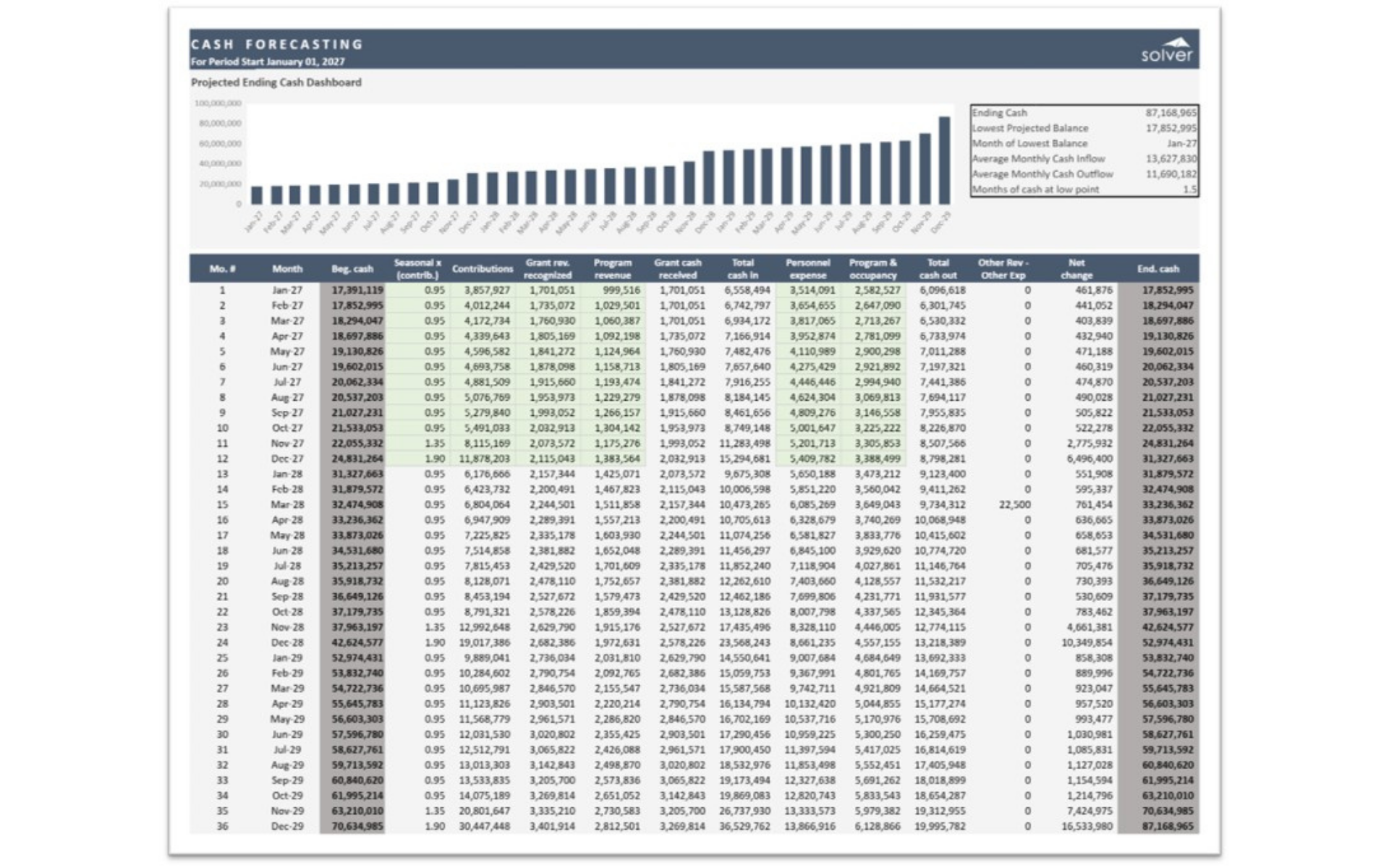
The Cash Flow Forecast in Solver is a pre-built xFP&A planning template for the nonprofit industry. Designed for nonprofit organizations, it projects cash month by month over a 36-month horizon. A Projected Ending Cash dashboard charts the balance over time and summarizes key measures such as ending cash, the lowest projected balance, the month it occurs, average monthly inflows and outflows, and months of cash at the low point.
NOTE: This template is included as part of the Nonprofit Essentials.
Built for nonprofit organizations, this Solver planning template connects to your accounting data via the Solver Data Warehouse and writes approved inputs back for reporting. In addition, it forecasts contributions with seasonal factors, grant revenue recognized and received, program revenue, personnel and program and occupancy expenses, and calculates net change and ending cash for each month, with an Actual and Assumptions tab for inputs. It supports liquidity planning, board and lender reporting, and scenario analysis of fundraising seasonality.
What is the Cash Flow Forecast in Solver?
The Cash Flow Forecast is a pre-built xFP&A planning template in Solver designed for nonprofit organizations. It delivers a multi-year monthly cash forecast with a dashboard of ending cash and low-point liquidity.
Who uses this Solver template?
This planning template is used by CFOs, treasurers, and executive directors at nonprofit organizations who need forward-looking visibility into cash. It is particularly valuable for nonprofits with seasonal giving and grant payment timing.
Where does the data come from?
Data is sourced automatically from your general ledger, HR and payroll, grant management, and ERP systems through the Solver Data Warehouse, which integrates with platforms such as Microsoft Dynamics 365 Business Central, Dynamics 365 Finance, Acumatica, Sage Intacct, and other leading ERP solutions. Once connected, actuals and baseline data populate the template automatically, so budget owners only need to enter their assumptions.