


 Add to favorite


Retail – Simulation of Store Opening
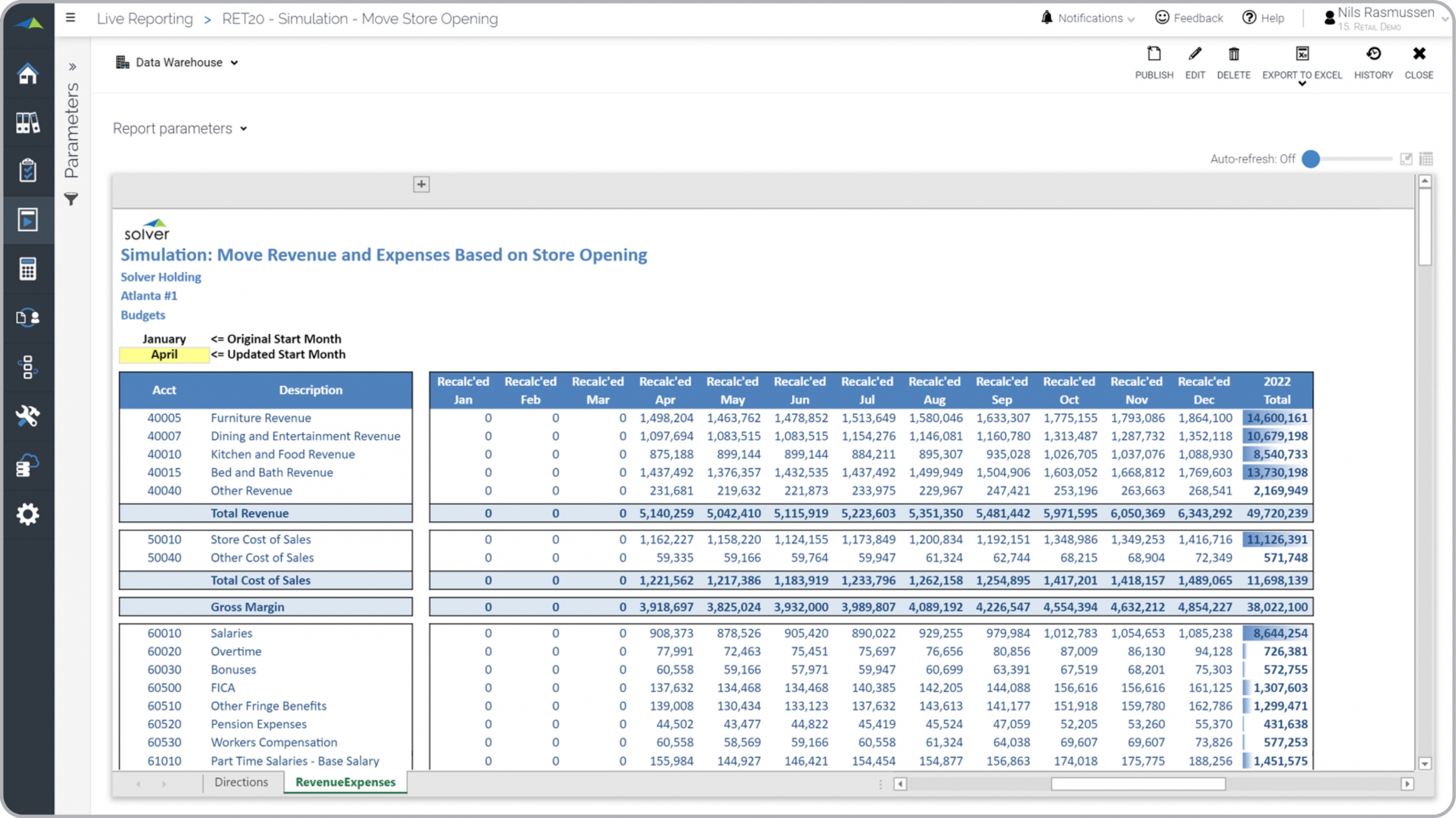
What is a Forecast for New Retail Store Opening? New retail store forecasts and budgets are considered essential planning tools in retail corporations and are used by financial managers and analysts to forecast revenues and expenses for a planned store opening. Some of the main functionality in this type of forecast model is that it allows the user to select data from a similar existing store that automatically will be pulled into the model. The user also selects the start (store opening) month, which will zero out prior months that year. At this point the forecast can be saved and it is done, or you can adjust any of the figures and then save.. An example of this type of forecast model can be found below.
Purpose of Automated Forecasts for New Store Openings Retail businesses use Automated Forecast Models to provide a very quick and easy way to create a forecast for a new store location based on actual or budget data from a similar size, existing store. It also makes it easy to perform what-if analysis and simulations related to potential store openings. When used as part of good business practices in Financial Planning & Analysis (FP&A) department, a company can improve its decisions, timing and success with business expansions as well as reduce the chances that poor financial planning results in bigger, operational issues.
Who Uses This Type of Forecast model? The typical users of this type of forecast model are: Store planners, CFOs and analysts. Other Forecast model s Often Used in Conjunction with Automated Forecasts for New Store Openings Progressive Financial Planning & Analysis (FP&A) departments sometimes use several different Automated Profit & Loss forecasts, along with general sales forecasts and budgets, sales dashboards, KPI dashboards, consolidation reports, balance sheets and cash flow statements and other management and control tools.
Where Does the Data for Analysis Originate From? The Actual (historical transactions) data typically comes from management systems or enterprise resource planning (ERP) systems. In analyses where budgets or forecasts are used, the planning data most often originates from in-house Excel spreadsheet models or from professional xFP&A solutions.
Built for retail finance teams and aligned with Solver's xFP&A platform, this Solver report template connects directly to your ERP data via the Solver Data Warehouse, enabling near real-time analysis with minimal setup. Designed for QuickStart deployment, it can be activated rapidly so your team can focus on analysis and decisions — not data preparation.
What is the Retail – Simulation of Store Opening in Solver? The Retail – Simulation of Store Opening is a pre-built xFP&A report template in Solver designed for retail organizations. It delivers key financial and operational metrics in a single, easy-to-use interface — purpose-built for retail finance workflows.
Who uses this Solver report template? This template is primarily used by CFOs, FP&A managers, and retail finance teams in retail organizations who need accurate, timely data to support planning, reporting, and decision-making. It is particularly valuable for retail finance teams managing budgets, forecasts, and performance reviews.
Where does the data come from? Data is sourced automatically from your ERP system through the Solver Data Warehouse. Once connected, the template updates in near real-time with no manual data entry required.
To learn more, visit the Resource Library.