



 Add to favorite



P&L – Top-Down Driver Based Forecast Template
Who uses Profit & Loss Top Down Driver-based Forecasts and What are Some Key Analytical Features? In today’s fast-paced business environment, Budget Manager are under high pressure to supply end users like executives with timely and concise forecasts, often on a quarterly or monthly basis. Companies use key features like the ones below to support their users with effective analysis that helps drive more informed and quicker decisions:
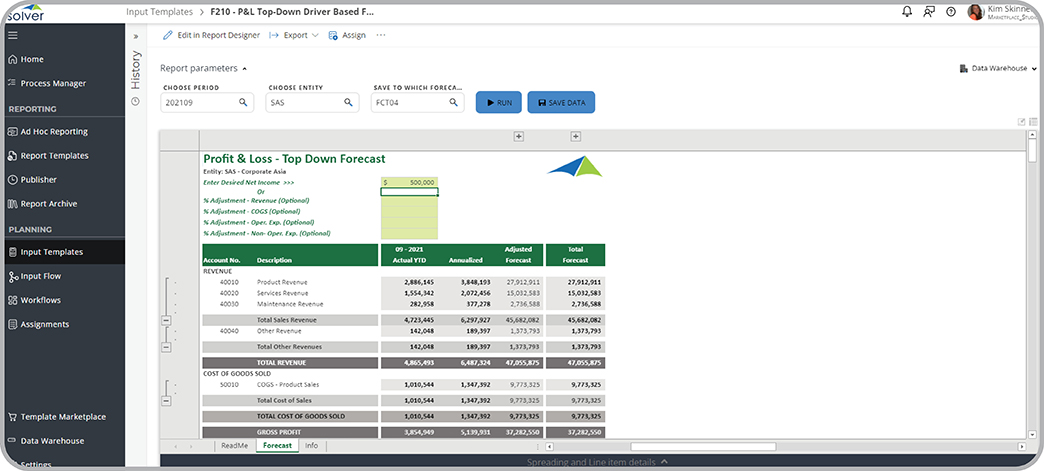
- Input of drivers like Target Net Income and adjustments that automatically generate forecast figures for the remaining periods of the year
- Conveniently available actual year-to-date figures with automated annualization
- Expandable (seen collapsed in the image below) columns and rows to view individual periods and GL accounts
A Brief Description of the Profit & Loss Top Down Driver-based Forecast Template Forecast input forms like the one seen in the image above are interactive and parameter driven and typically contain sections with revenues, expenses, sub-totals and totals. One of the important features that aid the user in the analysis process is the ability to automatically generate monthly forecast figures. Profit & Loss Top Down Driver-based Forecasts are often used in conjunction with bottom-up forecast- and annual budget templates, P&L reports, balance sheets, cash flow reports, and budget/forecast analysis dashboards.
Data Integration to Transaction Systems Most organizations these days want automated and streamlined planning, reporting and analysis. However, many of the benefits described earlier rely on best of breed extended financial planning and analysis (xFP&A) tools and/or Business Intelligence (BI) capabilities as well as data marts or data warehouses that use pre-built integrations to the organization’s ERP system. Oftentimes, they also need integrations to other key data sources like CRM, subscription systems, payroll tools, etc. Modern, cloud-based ERPs like Microsoft Dynamics 365 Finance (D365 Finance), Microsoft Dynamics 365 Business Central (D365 BC), Sage Intacct, Acumatica, Netsuite and SAP have robust APIs which allow for dynamic integrations to xFP&A and BI tools that are fully automated and flexible to run on a schedule or on-demand.
This Solver planning template connects directly to your ERP data via the Solver Data Warehouse, enabling near real-time analysis with minimal setup. Designed for QuickStart deployment, it can be activated rapidly so your team can focus on analysis and decisions — not data preparation.
What is the P&L – Top-Down Driver Based Forecast Template in Solver? The P&L – Top-Down Driver Based Forecast Template is a pre-built xFP&A planning template in Solver that allows finance and business teams to submit planning data directly in Solver, with automatic roll-up to consolidated budget and forecast models.
Who uses this Solver planning template? Budget owners, department managers, and CFOs, FP&A managers, and budget owners use this planning template to enter and submit financial data directly in Solver. It is particularly valuable during annual budgeting and rolling forecast cycles.
Where does the data come from? Data is sourced automatically from your ERP system through the Solver Data Warehouse, which integrates with platforms such as Microsoft Dynamics 365 Business Central, Dynamics 365 Finance, Acumatica, Sage Intacct, and other leading ERP solutions. Once connected, the template updates in near real-time with no manual data entry required.