



 Add to favorite



Government – Encumbrance Report
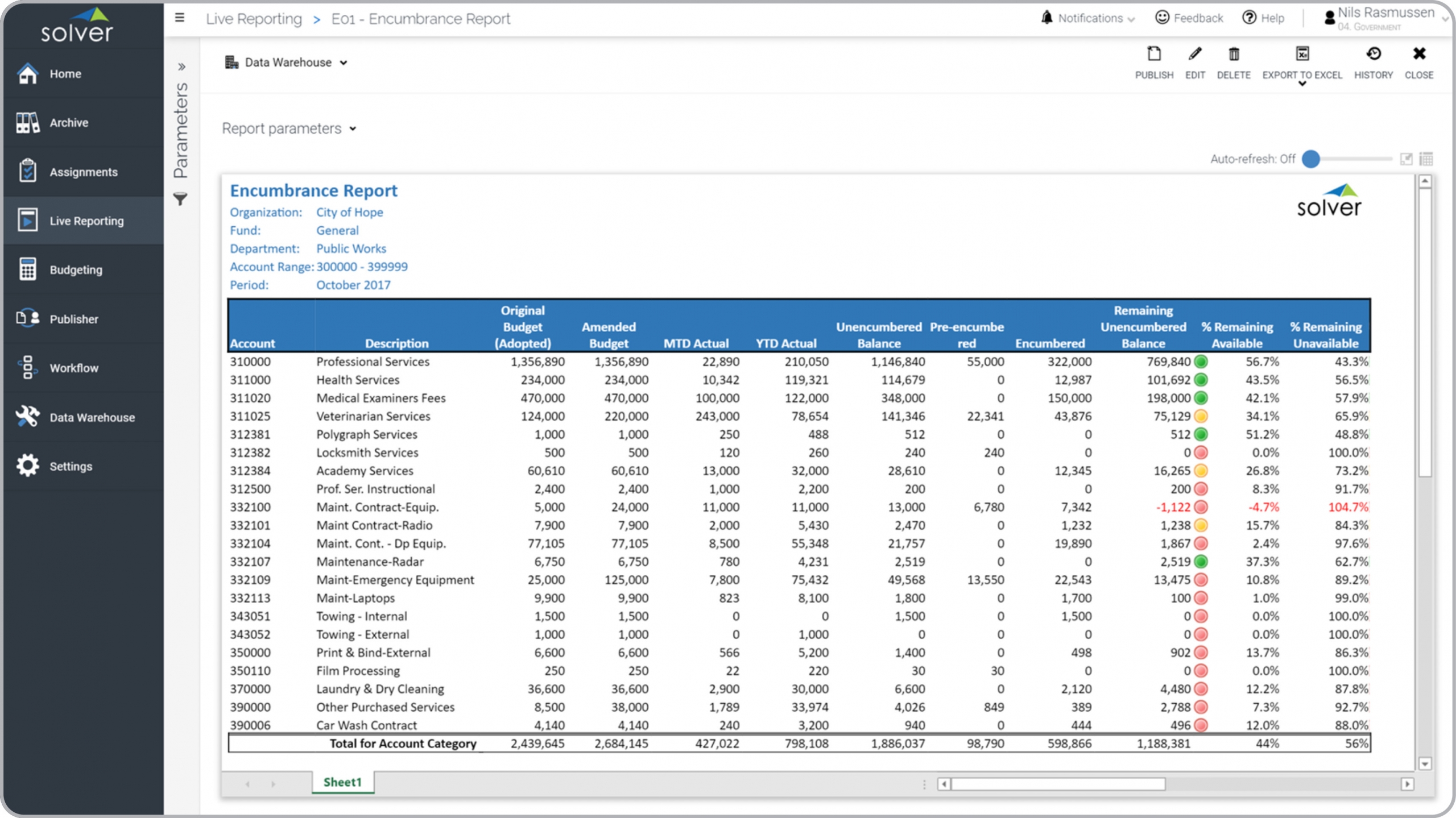
What is an Encumbrance Report for Public Sector Organizations? Monthly Encumbrance Reports are considered financial analysis tools and are used by CFOs and Accountants to track encumbrances and remaining balances by fund. Some of the main functionality in this type of monthly financial statement is that it enables the user to select any account category, period and fund to see the exact financial status. The columns in the report include: 1) Original (adopted) budget, 2) Amended budget, 3) Monthly actual balances, 4) Year-to-date (YTD) actual balances, 5) Unencumbered balance, 6) Pre-encumbered balance, 7) Encumbered amounts, 8) Remaining unencumbered balance, 9) Percent remaining available, and 10) Percent remaining unavailable. The rows of the report dynamically displays the accounts (object codes) selected by the user at runtime. You find an example of this type of monthly financial report below.
Purpose of Encumbrance Reports Public Sector organizations use Encumbrance Reports to get an exact picture of their monthly and YTD encumbrances. When used as part of good business practices in Accounting departments, a government entity can improve its financial decisions and analysis, and it can reduce the chances that accounting accuracy is reduced due to lack of clear encumbrance reporting.
Who Uses This Type of Monthly financial report? The typical users of this type of monthly financial report are: CFOs, controllers, accountants. Other Reports Often Used in Conjunction with Encumbrance Reports Progressive Accounting departments sometimes use several different Encumbrance Reports, along with core monthly financial statements, encumbrance dashboards, KPI reports, annual budgets and other management and control tools.
Where Does the Data for Analysis Originate From? The Actual (historical transactions) data typically comes from enterprise resource planning (ERP) systems like: Microsoft Dynamics 365 (D365) Finance, Microsoft Dynamics 365 Business Central (D365 BC), Microsoft Dynamics AX, Microsoft Dynamics NAV, Microsoft Dynamics GP, Microsoft Dynamics SL, Sage Intacct, Sage 100, Sage 300, Sage 500, Sage X3, SAP Business One, SAP ByDesign, Acumatica, Netsuite and others. In analyses where budgets or forecasts are used, the planning data most often originates from in-house Excel spreadsheet models or from professional xFP&A solutions.
Built for government finance teams and aligned with Solver's xFP&A platform, this Solver report template connects directly to your ERP data via the Solver Data Warehouse, enabling near real-time analysis with minimal setup. Designed for QuickStart deployment, it can be activated rapidly so your team can focus on analysis and decisions — not data preparation.
What is the Government – Encumbrance Report in Solver? The Government – Encumbrance Report is a pre-built xFP&A report template in Solver designed for government organizations. It delivers key financial and operational metrics in a single, easy-to-use interface — purpose-built for government finance workflows.
Who uses this Solver report template? This template is primarily used by CFOs, controllers, and public sector finance teams in government organizations who need accurate, timely data to support planning, reporting, and decision-making. It is particularly valuable for government finance teams managing budgets, forecasts, and performance reviews.
Where does the data come from? Data is sourced automatically from your ERP system through the Solver Data Warehouse, which integrates with platforms such as Microsoft Dynamics 365 Business Central, Dynamics 365 Finance, Acumatica, Sage Intacct, and other leading ERP solutions. Once connected, the template updates in near real-time with no manual data entry required.
To learn more, visit the Resource Library.