



 Add to favorite



Accounts Receivable Detail
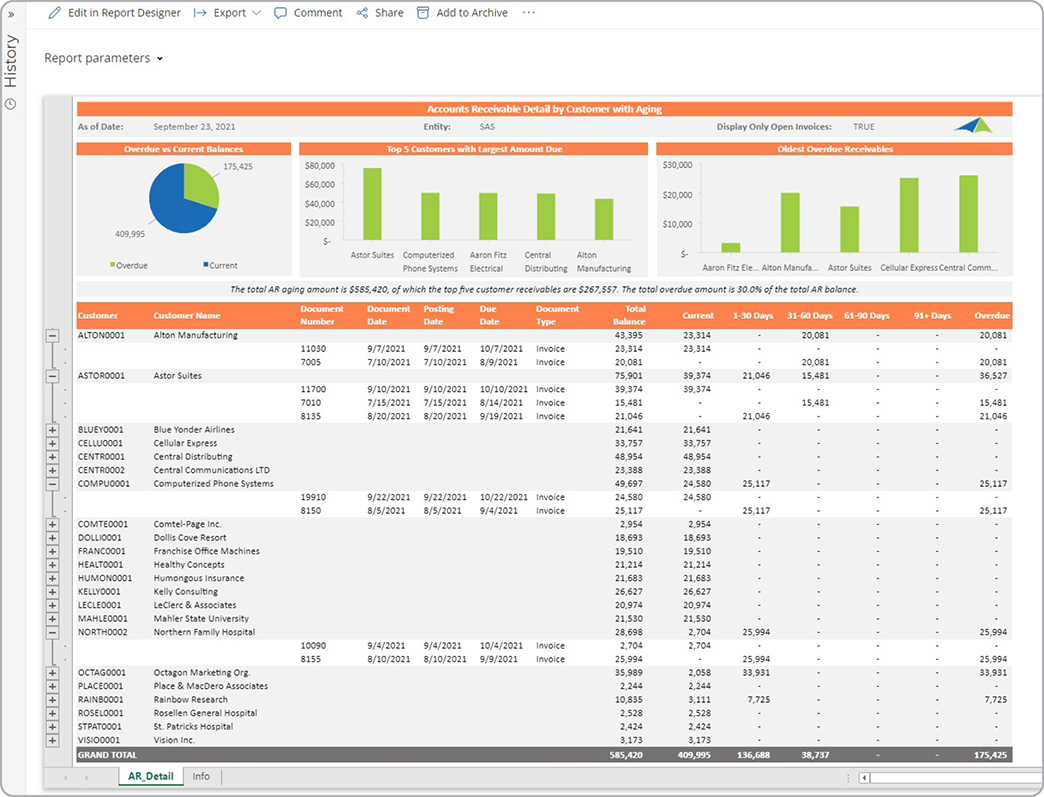
Who uses Accounts Receivable (AR) Detail Reports and What are Some Key Analytical Features? In today’s fast-paced business environment, Accounting and Collections Managers are under high pressure to supply end users like collections staff and accountants with timely and concise Accounts Receivable Reports. Companies use key features like the ones below to support their users with effective analysis that helps drive improved cash flow and AR aging visibility:
- Receivables detail by customer, including invoice numbers, invoice dates, invoice amounts and categorized aging of outstanding invoices
- The detail list in the lower portion of the report has the option to include only open items, closed items, or all items
- Graphical view of total AR balances, Top 5 customers by amount due, and oldest overdue invoices
Data Integration to Transaction Systems Most organizations these days want automated and streamlined planning, reporting and analysis. However, many of the benefits described earlier rely on best of breed extended financial planning and analysis (xFP&A) tools and/or Business Intelligence (BI) capabilities as well as data marts or data warehouses that use pre-built integrations to the organization’s ERP system. Oftentimes, they also need integrations to other key data sources like CRM, subscription systems, payroll tools, etc. Modern, cloud-based ERPs like Microsoft Dynamics 365 Finance (D365 Finance), Microsoft Dynamics 365 Business Central (D365 BC), Sage Intacct, Acumatica, Netsuite and SAP have robust APIs which allow for dynamic integrations to xFP&A and BI tools that are fully automated and flexible to run on a schedule or on-demand.
This Solver report template connects directly to your ERP data via the Solver Data Warehouse, enabling near real-time analysis with minimal setup. Designed for QuickStart deployment, it can be activated rapidly so your team can focus on analysis and decisions — not data preparation.
What is the Accounts Receivable Detail in Solver? The Accounts Receivable Detail is a pre-built xFP&A report template in Solver that delivers key financial and operational metrics in a single, easy-to-use interface, eliminating the need for manual data work or custom report development.
Who uses this Solver report template? CFOs, FP&A managers, and controllers use this report template to support month-end close, variance analysis, and management reporting. It is designed to be self-service and require no custom development.
Where does the data come from? Data is sourced automatically from your ERP system through the Solver Data Warehouse, which integrates with platforms such as Microsoft Dynamics 365 Business Central, Dynamics 365 Finance, Acumatica, Sage Intacct, and other leading ERP solutions. Once connected, the template updates in near real-time with no manual data entry required.