


 Add to favorite


GL Budget Dashboard – Profit Margins
Who uses Profit Margin Budget Dashboards and What are Some Key Analytical Features? In today’s fast-paced business environment, Budget Managers are under high pressure to supply end users like board members and executives with timely and concise Budget Dashboards. Companies use key features like the ones below to support their users with effective analysis that helps drive strategically aligned budgets.
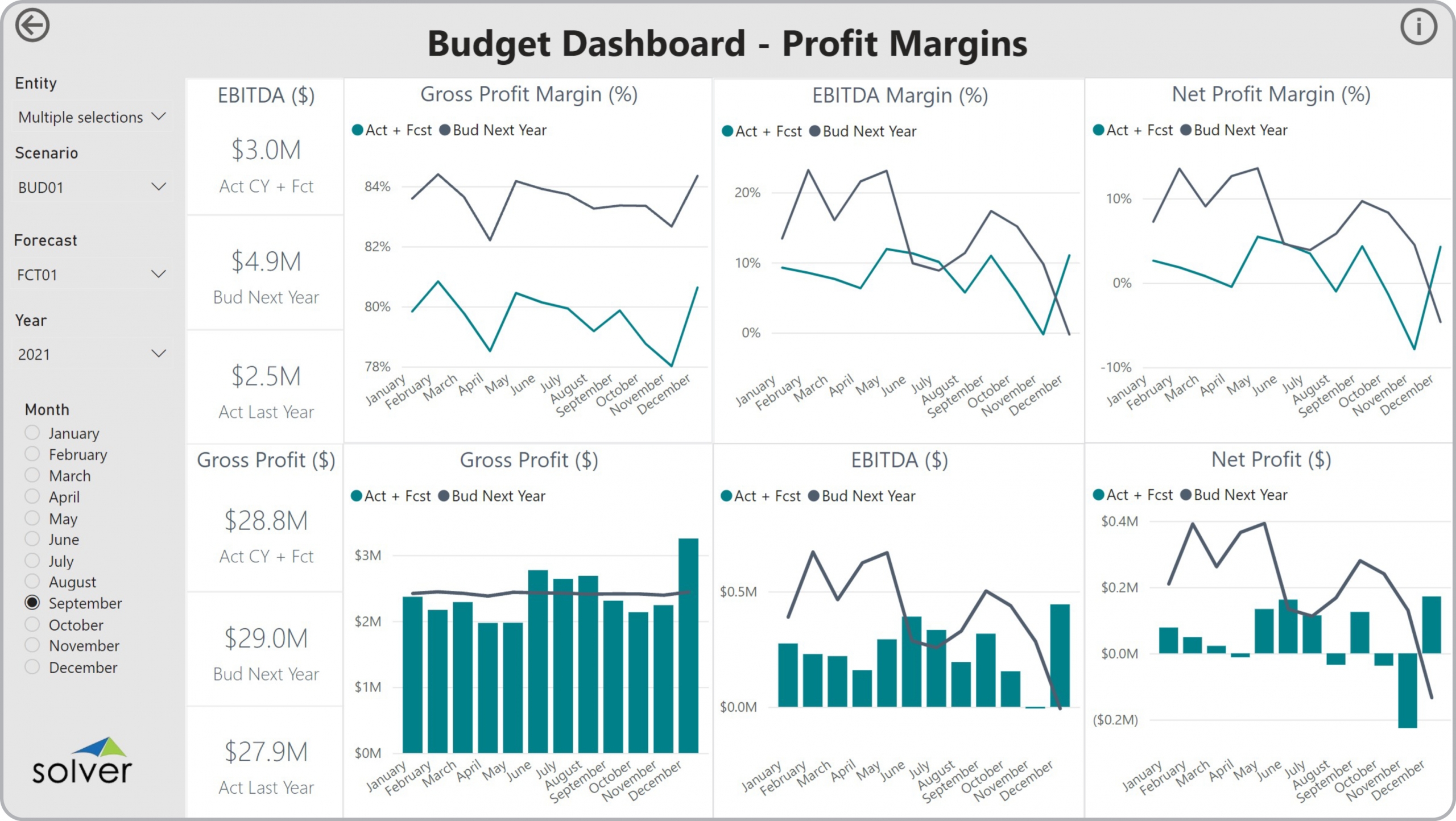
- Actual YTD plus Forecast current year versus the Budget for next year
- Profit metrics shown both as amounts and in percent
- Interactive trend charts comparing current year estimate (Actual YTD + Forecast) with next year's budget
A Brief Description of the Profit Margin Budget Dashboard Template Budget Dashboards like the one seen in the image above are interactive and parameter driven and typically contain sections with trend charts and KPIs for Gross Profit, EBITDA and Net Profit. One of the important features that aid the user in the analysis process is the ability to select the last closed period and the entire dashboard will automatically display profitability estimates (Actual YTD + Forecast) for the current year and compare these to the budget for next year. Profit Margin Budget Dashboards are often used in conjunction with revenue and expense budget input templates, revenue/expense budget dashboards and profit & loss budget reports.
Data Integration to Transaction Systems Most organizations these days want automated and streamlined planning, reporting and analysis. However, many of the benefits described earlier rely on best of breed extended financial planning and analysis (xFP&A) tools and/or Business Intelligence (BI) capabilities as well as data marts or data warehouses that use pre-built integrations to the organization’s ERP system. Oftentimes, they also need integrations to other key data sources like CRM, subscription systems, payroll tools, etc. Modern, cloud-based ERPs have robust APIs which allow for dynamic integrations to xFP&A and BI tools that are fully automated and flexible to run on a schedule or on-demand.
This Solver dashboard template connects directly to your ERP data via the Solver Data Warehouse, enabling near real-time analysis with minimal setup. Designed for QuickStart deployment, it can be activated rapidly so your team can focus on analysis and decisions — not data preparation.
What is the GL Budget Dashboard – Profit Margins in Solver? The GL Budget Dashboard – Profit Margins is a pre-built xFP&A dashboard template in Solver that delivers key financial and operational metrics in a single, easy-to-use interface, eliminating the need for manual data work or custom report development.
Who uses this Solver dashboard template? Cfos, fp&a managers, and business unit leaders use this Solver dashboard template to replace static spreadsheet reports with interactive, near real-time analysis. It supports both ongoing monitoring and ad hoc deep-dives into performance data.
Where does the data come from? Data is sourced automatically from your ERP system through the Solver Data Warehouse. Once connected, the template updates in near real-time with no manual data entry required.